
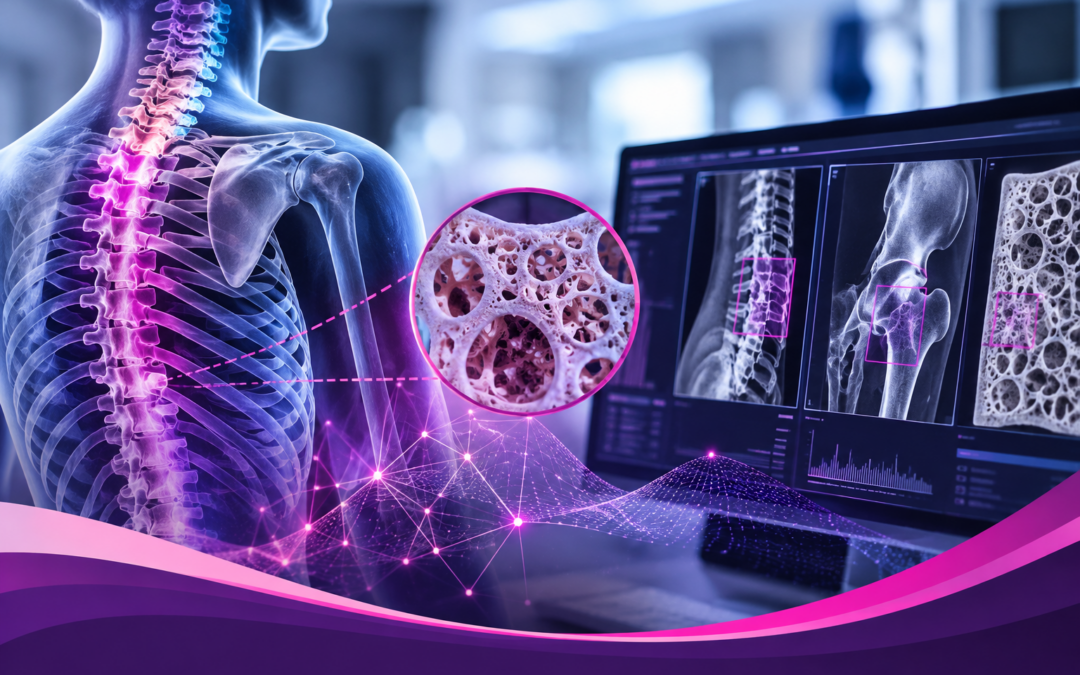
Artificial intelligence is appearing everywhere — in our phones, workplaces, cars and even the way healthcare is delivered.
But what does AI actually have to do with osteoporosis and broken bones? Quite a lot, as it turns out.
From helping identify fractures on X-rays to finding signs of osteoporosis on scans taken for completely different reasons, artificial intelligence is increasingly being studied as a tool that could help healthcare professionals spot problems earlier and make better use of the medical information already available.
This October, NOFSA is Breaking IT Down and looking at a question that may shape the future of bone health: Can artificial intelligence help us find fragile bones before the next fracture happens?
First, what do we mean by AI?
Artificial intelligence is a broad term used for computer systems that can analyse information, identify patterns and perform certain tasks that would traditionally require human interpretation.
In healthcare, AI does not mean asking a chatbot to diagnose you. One of its most promising uses is in medical imaging, where specialised algorithms can be trained to analyse large numbers of X-rays, CT scans and other images and recognise patterns associated with disease or injury.
For bone health, that opens some interesting possibilities.
- AI can help spot fractures
An X-ray remains one of the most common tools used when a fracture is suspected. Some fractures are obvious. Others can be subtle, particularly when imaging is being assessed in a busy emergency environment.
AI systems are being developed to act as an additional set of “eyes”, highlighting areas on an X-ray that may contain a fracture for the healthcare professional to review. A 2024 systematic review and meta-analysis involving 100 studies found strong overall diagnostic performance for AI systems detecting fractures on plain radiographs. The researchers concluded that fracture detection is one of the most extensively studied applications of AI in medicine.
Other reviews have found that using AI alongside clinicians may help improve fracture detection and workflow efficiency. Importantly, the role being explored is one of clinical support rather than replacing the radiologist or doctor.
- A scan taken for one reason could reveal something else
One particularly exciting area is called opportunistic screening.
Imagine having a CT scan for an unrelated medical reason. That scan may already contain information about the quality of your bones. Traditionally, nobody may have been specifically looking for osteoporosis because that was not why the scan was requested. AI could potentially analyse existing CT images and flag signs associated with low bone strength or previously unnoticed vertebral fractures.
A recent systematic review described the potential for AI to use CT scans already obtained for other clinical reasons to assess bone quality, potentially providing osteoporosis screening information without requiring additional radiation exposure from that CT assessment itself. For a condition that frequently remains undiagnosed until a fracture occurs, that possibility is significant.
- AI could help us understand fracture risk
Osteoporosis care is not simply about finding low bone mineral density.
Healthcare professionals consider a combination of factors when estimating fracture risk, including age, previous fractures, medical history, medication use, bone density and other clinical information. Researchers are investigating whether machine-learning systems can identify more complex patterns within this information and medical imaging. Recent reviews suggest AI may become a useful complementary tool for fracture-risk assessment and osteoporosis detection, although researchers continue to emphasise the need for strong clinical validation before widespread use.
In other words, AI may eventually help answer a more useful question than simply: “How dense are this person’s bones?” It could help healthcare teams consider: “How likely is this person to fracture — and should we intervene sooner?”
- AI may help find people who are currently being missed
One of the challenges in osteoporosis is that it is often silent. You cannot feel your bones becoming weaker. For many patients, the first indication of osteoporosis is a fragility fracture.
This creates an important opportunity for technology. Medical systems already contain enormous amounts of information — scans, X-rays and clinical records. If AI can help identify patterns within information that already exists and draw attention to people who may need further assessment, it could potentially help close part of the osteoporosis diagnosis gap. Researchers are even investigating AI-based osteoporosis screening from unexpected sources, including dental panoramic X-rays, although evidence quality and performance still vary considerably between systems.
But AI is not a doctor
This is perhaps the most important part of the conversation. AI can make mistakes.
Algorithms depend on the information used to train them. A system that performs well in one population, hospital or type of scan may not necessarily perform equally well everywhere. Researchers continue to highlight challenges including bias, data privacy, differences between populations, limited external validation and the need for clinical oversight.
That means AI should not be viewed as replacing doctors, radiologists, DXA operators or other healthcare professionals. Think of it instead as another potential tool in their toolbox. The computer may flag something.
The healthcare professional still has to interpret it in the context of the person sitting in front of them.
What does this mean for patients today?
For most people, the basics of osteoporosis care have not changed.
You should still:
- Know your osteoporosis risk factors.
- Discuss previous fractures with your healthcare provider.
- Ask whether a DXA scan is appropriate for you.
- Take prescribed osteoporosis medication as directed.
- Support your bones through appropriate nutrition and movement.
- Take falls prevention seriously.
- Seek professional advice if you are concerned about your bone health.
AI does not replace these steps. What it may change is our ability to find people at risk earlier and use medical information more intelligently.
From repairing fractures to preventing the next one
Perhaps the most exciting potential of AI is not simply identifying a broken bone faster. It is what happens next.
A fracture should prompt an important question: Why did this bone break?
If technology helps connect that fracture with osteoporosis assessment, risk evaluation and appropriate follow-up, we have the opportunity to move from simply repairing broken bones to preventing future fractures.
And that is where technology becomes truly meaningful. Not AI for the sake of AI. Not technology replacing people. But technology helping healthcare professionals notice what might otherwise have been missed.
This October, NOFSA is Breaking IT Down
Throughout October, we’ll explore how artificial intelligence is entering the world of bone health — from fracture detection and medical imaging to osteoporosis screening and fracture-risk assessment. We’ll separate the science from the hype and ask what these developments could mean for patients and healthcare professionals. Because the future of osteoporosis care may involve smarter technology.
But the goal remains very human: Earlier detection. Better care. Fewer broken bones.