
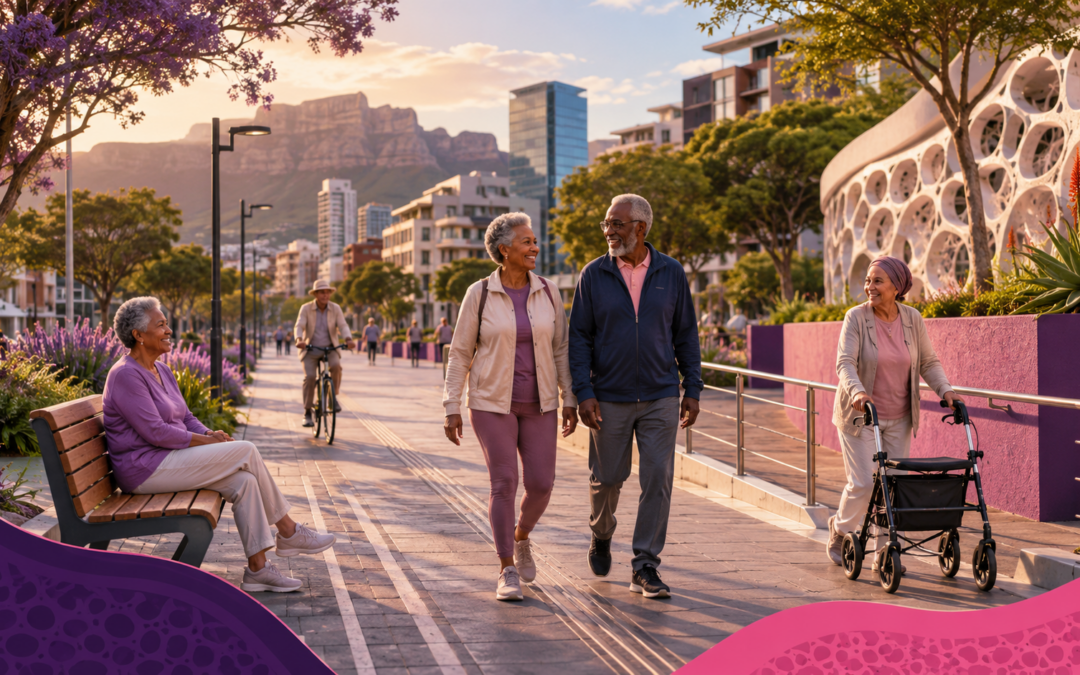
South Africa is ageing.
For many years, conversations around health, infrastructure, housing, transport, and community planning have focused mainly on children, youth, and working-age adults. These remain essential priorities, but there is another reality we can no longer ignore: more South Africans are growing older, and our communities must be ready to support them.
According to Statistics South Africa, the number of people aged 60 years and older increased from 3.6 million in 2002 to 6.6 million in 2025, representing 10.5% of the population. This is not a small group. It is a growing part of our society, and one that deserves to age with dignity, safety, independence, and full participation in community life.
So, the question is simple: Where are our age-friendly cities?
What Is an Age-Friendly City?
An age-friendly city or community is one that actively supports people to live well as they age.
The World Health Organization describes age-friendly environments as places that promote health, participation, and security in order to improve quality of life as people grow older.
This means more than simply having clinics, care homes, or retirement villages. It means creating towns, cities, neighbourhoods, and public spaces where older adults can continue to move, connect, contribute, access services, and live with confidence.
An age-friendly city asks practical questions:
- Can older people walk safely in their neighbourhoods?
- Can they access transport without fear or difficulty?
- Are pavements even and well maintained?
- Are public spaces well lit?
- Are benches available for rest?
- Are buildings accessible?
- Is healthcare easy to reach?
- Are older adults included in planning and decision-making?
These are not luxuries. They are the basics of dignity.
Age-Friendly Cities Are About Independence
For older adults, independence is often closely linked to mobility. The ability to walk to a shop, attend a clinic appointment, visit family, join a community group, or move safely around the home can make the difference between active ageing and isolation. This is where bone health becomes central.
Osteoporosis, reduced muscle strength, poor balance, and falls risk can all affect an older person’s ability to remain active and independent. A single fracture can change someone’s life dramatically, leading to pain, loss of confidence, reduced mobility, dependence on caregivers, or even long-term institutional care.
Age-friendly cities are therefore not only about urban planning. They are also about prevention. They help reduce risk by creating environments where older adults can move safely, remain visible, and participate in daily life.
The Link Between Osteoporosis and Age-Friendly Environments
Osteoporosis is often called a silent disease because many people do not know their bones are weakening until a fracture occurs. For older adults, the consequences of fractures can be severe.
An age-friendly environment can support bone health and fracture prevention in very practical ways:
- Safe pavements reduce trip hazards.
- Good lighting reduces falls risk.
- Accessible transport helps older adults reach healthcare appointments.
- Community exercise spaces encourage movement and balance.
- Public seating allows people to rest when needed.
- Home safety awareness can prevent avoidable falls.
- Community education helps people understand risk factors and screening.
When cities are not designed with older people in mind, the environment itself can become a health risk. A loose paving stone, poor lighting, a lack of handrails, inaccessible transport, or unsafe crossings may seem minor to some people — but for an older adult with osteoporosis, these can be life-changing hazards.
Where Does South Africa Stand?
Globally, the WHO Global Network for Age-friendly Cities and Communities includes more than 1,800 cities and communities across 60 countries, covering over 400 million people.
The network allows communities to share ideas, learn from one another, and commit to creating better places to grow older. The WHO’s Age-Friendly World platform also allows users to browse cities, communities, and network affiliates that are part of this global movement.
But in South Africa, the concept of age-friendly cities still needs far more public attention, practical implementation, and local ownership.
We need to ask:
- Which municipalities are actively planning for older residents?
- Which communities are measuring falls risk in public spaces?
- Which city planners are consulting older adults directly?
- Which public health strategies are linking ageing, mobility, osteoporosis, and prevention?
- Which local governments are treating healthy ageing as a planning priority rather than a private family responsibility?
Ageing is not only a healthcare issue. It is a housing issue, a transport issue, a safety issue, a social inclusion issue, and a human rights issue.
What Would an Age-Friendly South African Community Look Like?
An age-friendly South African community would not need to be expensive or complicated. Many improvements are practical and achievable.
It would include:
Safer walking spaces
Even pavements, safe crossings, visible signage, and fewer trip hazards.
Accessible public transport
Transport that older adults can use safely, affordably, and with dignity.
Community movement opportunities
Walking groups, balance classes, gentle strength programmes, and safe public spaces for activity.
Better access to screening and care
Awareness around osteoporosis risk, DXA scans, falls prevention, medication support, and referral pathways.
Public spaces that encourage participation
Benches, shade, toilets, ramps, and community venues that allow older people to remain active and socially connected.
Respect and inclusion
Older adults should not be treated as passive recipients of care. They should be heard, consulted, and included in decisions that affect their lives.
Home safety awareness
Families and caregivers should be supported with practical advice on reducing falls risk at home.
Age-Friendly Cities Benefit Everyone
One of the most important truths about age-friendly planning is this: when a city works better for older people, it works better for almost everyone.
A smooth pavement helps an older adult with reduced balance, but it also helps a parent pushing a pram.
Good lighting helps prevent falls, but it also improves community safety.
Accessible transport helps older people attend appointments, but it also supports people with disabilities.
Benches and shaded spaces help older adults rest, but they also make public areas more welcoming for all.
Age-friendly design is not special treatment. It is good design.
The Role of NOFSA
At NOFSA, we believe that healthy ageing must include bone health. Strong bones and muscles help older adults stay mobile, independent, and connected. But individuals cannot carry the full responsibility alone. Environments must support safe movement, access to care, and prevention. This means osteoporosis awareness should form part of broader healthy ageing conversations, including:
- falls prevention
- screening and early diagnosis
- medication adherence
- nutrition
- exercise and balance
- home safety
- community support
- caregiver education
- age-friendly public spaces
If we want older adults to remain independent for longer, we need communities that help them do so.
The Question We Should Be Asking
South Africa does not only need more conversations about ageing. We need action. We need municipalities, healthcare professionals, urban planners, community organisations, families, and older adults themselves to ask:
Are our communities helping people age well — or are they making ageing harder?
Age-friendly cities are not a future luxury. They are a present need. As our older population grows, we must build communities where people can age with safety, mobility, dignity, and connection.
Because strong bones support strong bodies — but strong communities help people keep using them.